
White seabream
Diplodus sargus
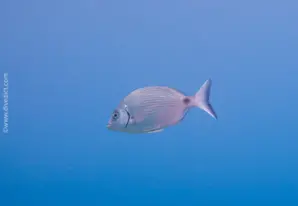




Special features
White seabream cannot decide on its sex: Some individuals are hermaphrodites, others change sex throughout their lives, and still others always remain with the same sex.
As they age, their dark streaks fade.
Appearance
They have a high-backed, oval, laterally flattened body and several vertical stripes.
However, it has a rounded head shape and no pointed snout. It has a wide, black spot on the base of the tail root (caudal peduncle), which rests like a saddle.
The back edge of the caudal fin is black. The bream can be up to 45 cm long but usually stays at a length of 22 cm.
Natural enemies
Predatory fish
Dangerous/Venomous
The bream is neither dangerous nor venomous.
Sketch
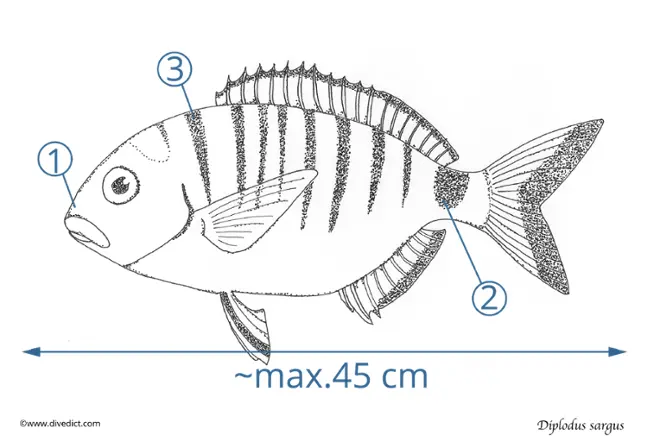
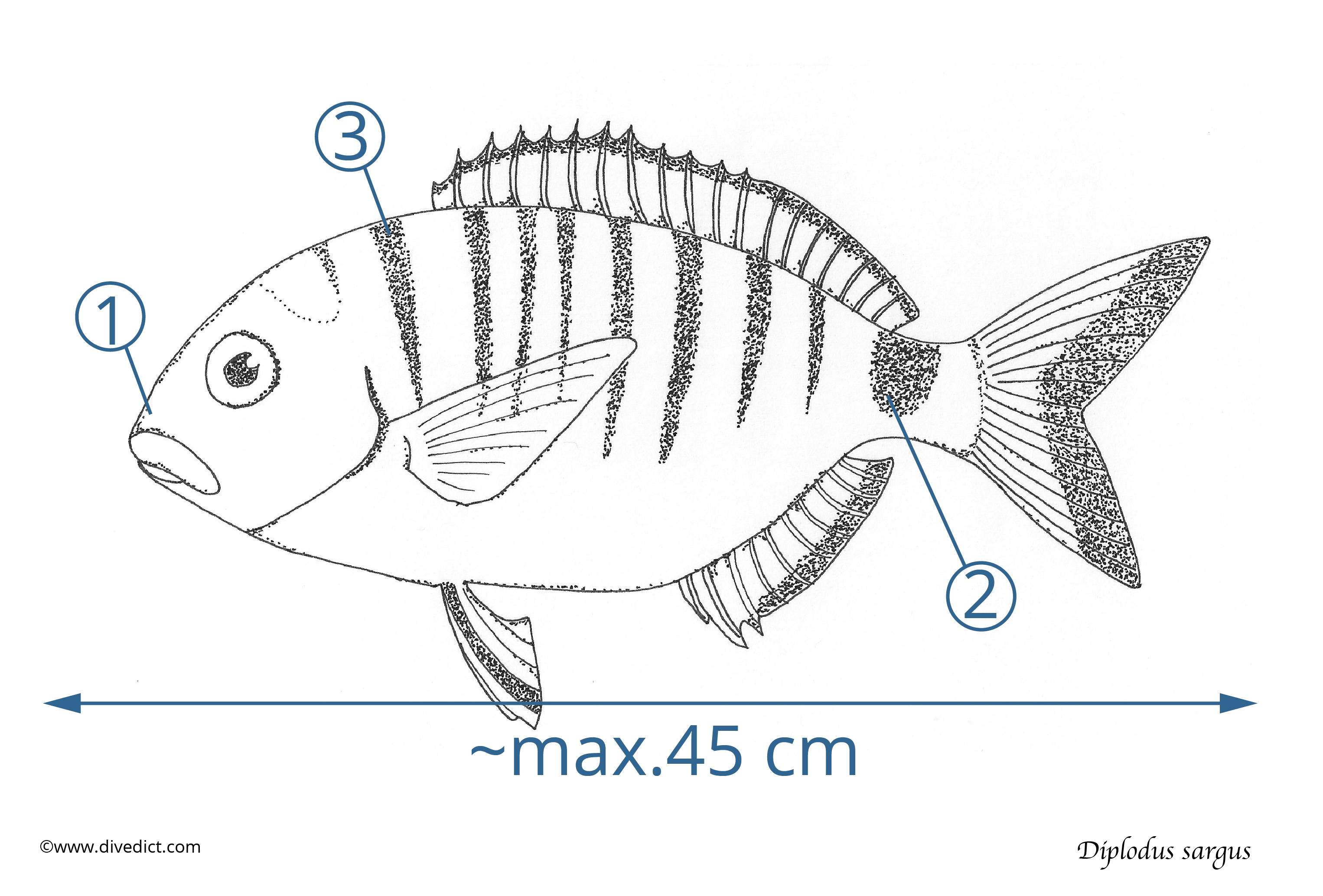
1. No pointed snout
2. Black spot on caudal peduncle
3. Only for young animals: vertical stripes
Pro tips
At dusk, white seabreams can be found in small groups on rocky reefs and in seagrass beds, often in surf zones, sometimes in brackish water.
Adult animals are shy, but young fish tend to be curious and come closer to take a look at divers.
Like an octopus, this bream can change the color of its stripes. When it is afraid, it enhances the color of these bands to disappear into the seaweed, where it hides.
Text: Carolina Leiter, Felician Hosp, Pia Balaka
Pic: Felician Hosp
Illustration: Dive Dict