
Where can I be found?
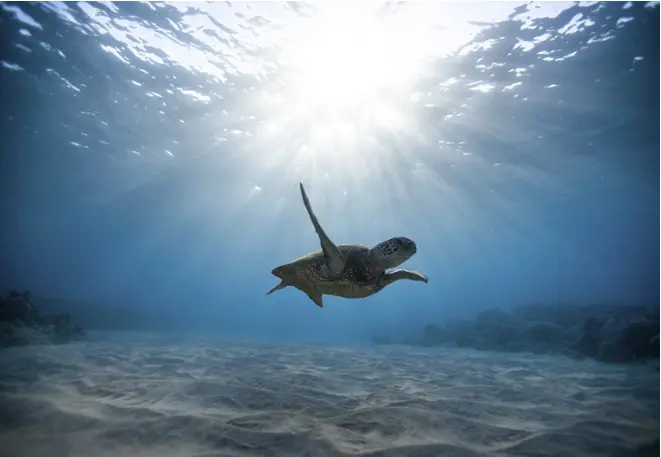
Vacation scenery as far as the eye can see: Here we are on a beautiful sandy beach that gently slopes into the sea.
Billions of fine grains of sand cover the seabed, where the waves create striped patterns known as ripples or ripple marks.

Why am I important?
You're wondering what's interesting about sand? Let's take a closer look at the grains:
The unevenness of the sand grain structure is home to thousands of different types of bacteria that make sand a key part of the ecosystem and the global nutrient cycle.
Among other things, these bacteria process carbon and nitrogen from seawater and incoming rivers.
As a result, sand acts like a giant, purifying filter - much of what seawater washes into the ground never comes out again.
Who am I giving home to?
Sandy soils are unstable habitats: since the grains of sand are constantly being moved by the currents, solid animals cannot settle here.
One of the survival strategies of tubeworms, for example, is to provide stability themselves: they live in homemade living tubes that are firmly anchored in the sand.
To catch and eat floating particles, they stretch their filters across the ground.
Another survival strategy is to go underground: Some organisms simply bury themselves completely in the sediment to protect themselves from Predators and constant movement.
Many mussels and snails use this tactic - their extended respiratory tubes give them constant access to the surface of the sand to breathe.
Irregular sea urchins are also perfectly adapted to their sandy habitat: with their modified body shape and hair-like spines, they can move through the sand at lightning speed.
In doing so, they function like small sewage treatment plants: They consume all the sand they pass through, digest the microorganisms and algae, and excrete the rest as clean sand. Sea cucumbers, which are found in large numbers on the sandy seafloor and swallow kilograms of sand and show a similar behaviour.
Even if some small creatures are well hidden under the sandy cover, that doesn't mean they're safe.
Some species of fish will rummage through the sand looking for hidden invertebrates to eat.
Other fish species are perfectly camouflaged and almost indistinguishable from the sandy bottom.
Therefore, even in shallow water, special care should be taken when walking, diving, or snorkeling: stingrays tend to burrow into the sand during the day, and the poisonous weever fish finds its hunting grounds on sandy bottoms.
What do I consist of?
I am the product of thousands of grains of sand ranging from 0.1 to 2 mm in diameter. These grains of sand are produced either by the death and decay of calcareous algae, or when rock decays and is crushed by boring sponges, boring Shells (no, they are not dull, they bore into rock), and rasping animals. Rivers can also crush debris into sand over long distances and transport it to the ocean.
Text: Carolina Leiter