
Dugongs
Dugong dugong




Special Features
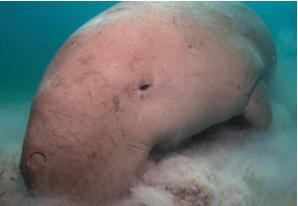
Dugongs are calm and rather shy animals. They usually live alone or in small groups; Sometimes loose gatherings can be seen where seagrass grows particularly abundantly. They spend most of their day feeding: With their sensitive, bristly snouts, they sift through the seabed and graze on seagrass. In doing so, they leave typical feeding trails in the sand.
They regularly surface for air but can stay underwater for several minutes. Dugongs move slowly and energetically, but can swim surprisingly fast in danger.
Appearance
Dugongs are large, robust marine mammals with a rounded, streamlined body. Their skin is thick, smooth, and usually gray to gray-brown, sometimes with small scars or lighter spots. Particularly striking is their broad, downward-facing snout, with which they graze seagrass from the seabed. Their front flippers are paddle-like and help with steering. Unlike manatees, dugongs have a forked, dolphin-like tail fin, with which they move calmly and evenly through the water.
They can grow up to three meters long and weigh several hundred kilograms. Despite their size, they appear surprisingly gentle and weightless in the water.
Natural Enemies
large shark species
Dangerous/Toxic
Dugongs are neither dangerous nor toxic.
Pro Tips
Always keep a sufficient distance from dugongs and stay calm in the water. Do not chase them or try to touch them, even if they seem curious. Make sure to never block their way to the surface, as they need to surface regularly for air. If a calf is present, keep an especially large distance and move slowly. Also, respect the seagrass beds and do not stir up sand, so their habitat remains undisturbed.