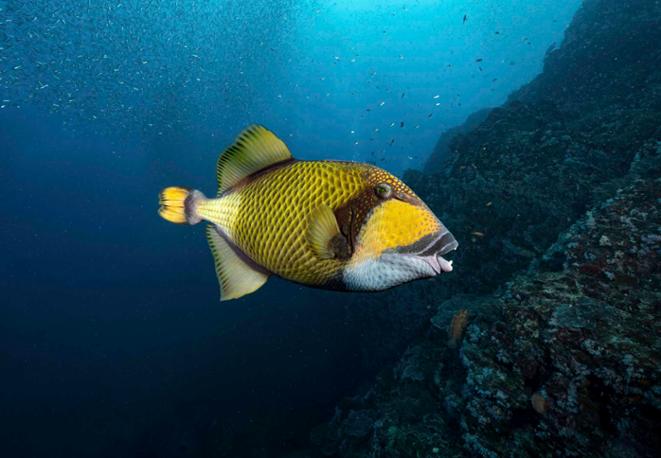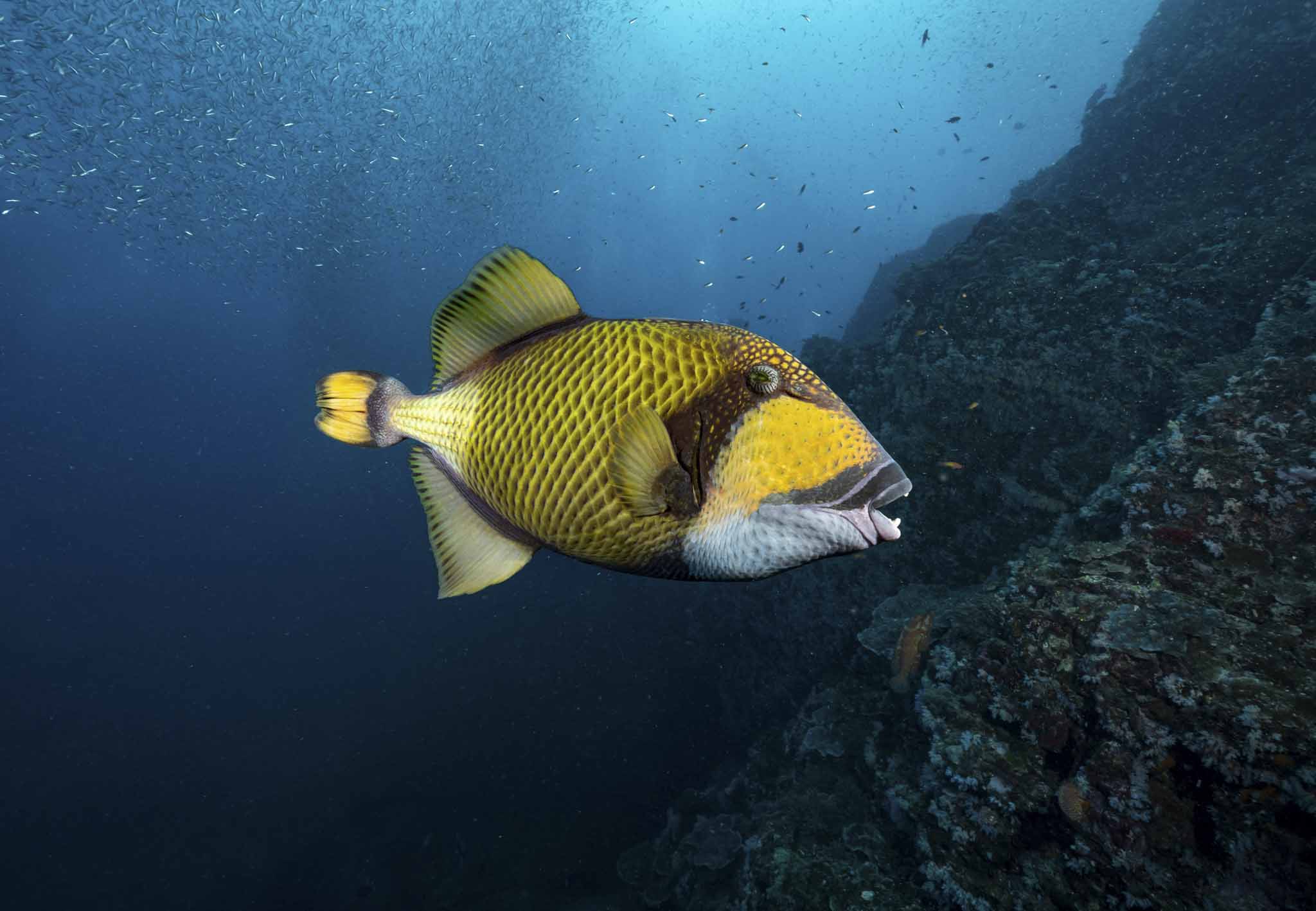
Titan triggerfish
Balistoides viridescens




Special Features
Like its relative, the clown triggerfish, the titan triggerfish has a "lock" on its back: The first dorsal spine can be locked into place by a smaller second spine, allowing the fish to wedge itself tightly into rock crevices.
This "trigger" mechanism serves not only for defense but also as a warning signal. When the titan feels threatened or disturbed, it raises the spine, tilts its body slightly to the side, and fixes the intruder with a stern gaze. This is the underwater equivalent of "Don't mess with me."
Especially during the breeding season, it displays strong territorial behavior. Females dig their nests in the sand and defend not only the nest itself but also an invisible, conical airspace above it. Divers who accidentally swim into this area can suddenly be attacked. The bite of a titan triggerfish is strong enough to break corals or bite through wetsuits, so it's best to keep your distance.
Like other triggerfish, the titan can produce grunting or thumping sounds by vibrating muscles around its swim bladder; a form of communication to warn rivals or interact with partners.
Appearance
The titan triggerfish lives up to its name: It is the largest representative of the triggerfish family, and you can see that. Its massive, diamond-shaped body, strong jaw, and striking color play of yellowish-green scales, dark bands, and bright blue lines around the mouth and fins make it a beautiful yet intimidating creature.
The skin is covered with rough, sandpaper-like scales that act like armor. The eyes are positioned high on the head and can move independently; perfect for keeping an eye on both prey and intruders. When it glides over the reef, it looks as if a small tank is patrolling.
Natural Enemies
Few: It is itself a large predator of the reef. Sharks can pose a threat to juveniles.
Dangerous/Toxic
Not toxic, but potentially very aggressive, especially during the breeding season.
Pro Tips
If you encounter a titan triggerfish while diving, admire it; but from a safe distance. Watch for warning signals such as the raised dorsal spine, lowered head position, or slow circling movements. That is your sign to back away calmly. Never turn your fins toward it, as this could trigger an attack.
Despite their feared reputation, titan triggerfish play an important role in the reef ecosystem. By eating sea urchins and coral debris, they help maintain ecological balance and prevent overgrowth. And when they are not busy defending their territory, they can appear surprisingly graceful.
Underwater photographers love them for their vibrant colors and distinctive facial patterns. But beware, this fish is not camera-shy, but camera-aware.