
Peacock hind
Cephalopholis argus




Special Features
The Peacock Hind is a territorial solitary fish that usually hides in caves, under rock ledges, or among corals during the day. At dusk, it becomes active and goes hunting. Its hunting technique: snap up quickly. Its diet mainly consists of small fish and crustaceans.
It is also a so-called protandrous hermaphrodite: All individuals start as females, and some transform into males over their lifetime. Males typically defend a small territory and maintain a harem of females.
Interestingly, the species was artificially introduced in Hawaii to promote fishing. There, it has become invasive and can negatively impact local fish communities as it is a very efficient predator.
Appearance
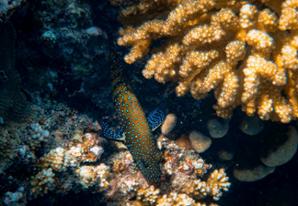
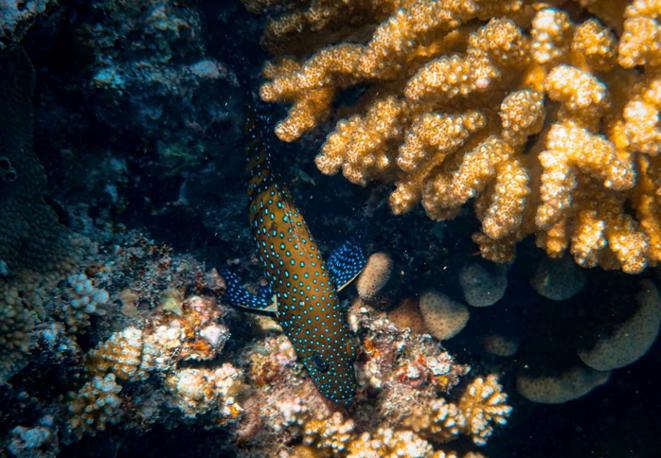
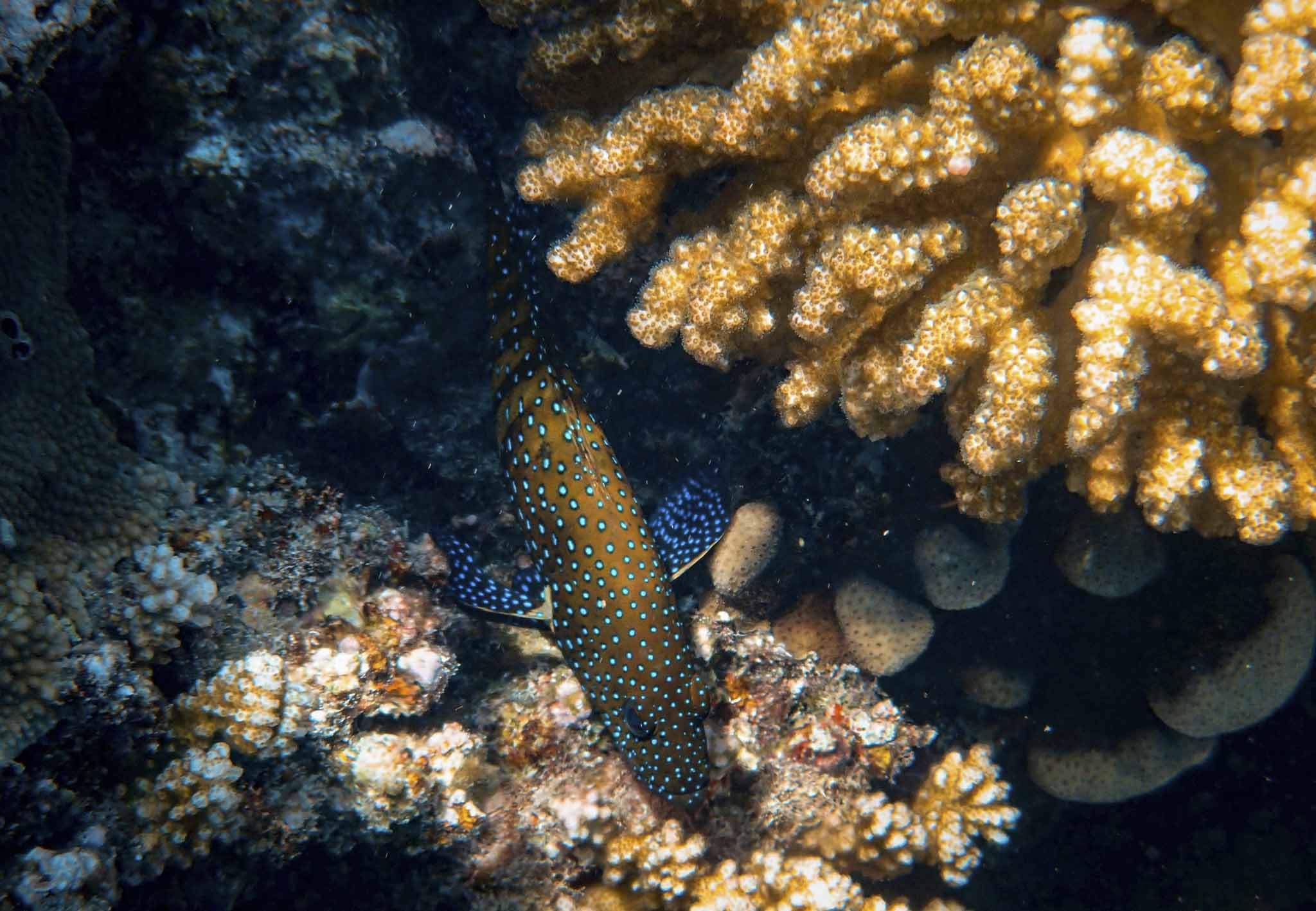
The Peacock Hind is a real eye-catcher in the reef: Its body is dark brown to olive and covered with striking, bright blue spots that extend over its body and fins. Depending on the lighting situation and mood, the base coloration can change slightly, which helps it camouflage even better in the reef.
On the sides, many specimens additionally show several dark, vertical stripes – this somewhat resembles a tiger's pattern. With its robust, slightly stocky body structure, large mouth, and distinctive pectoral fins, it looks like a typical ambush predator.
It can grow up to 60 cm long, but most individuals are smaller, in the range of 30 to 40 cm. Especially young specimens often stay closer to the reef, while older ones also seek deeper and open areas.
Natural Enemies
larger groupers, diving sea birds, sharks
Dangerous/Toxic
The Peacock Hind is not dangerous, but its consumption can be harmful to health.
Pro Tips
The Peacock Hind is easy to recognize with its many blue spots – it often sits motionless under rock ledges or in caves during the day. If you want to spot it, look closely at reef edges and overhangs!
Caution when consuming in tropical regions: It may contain ciguatoxin, a natural nerve toxin that is not destroyed by cooking or freezing.