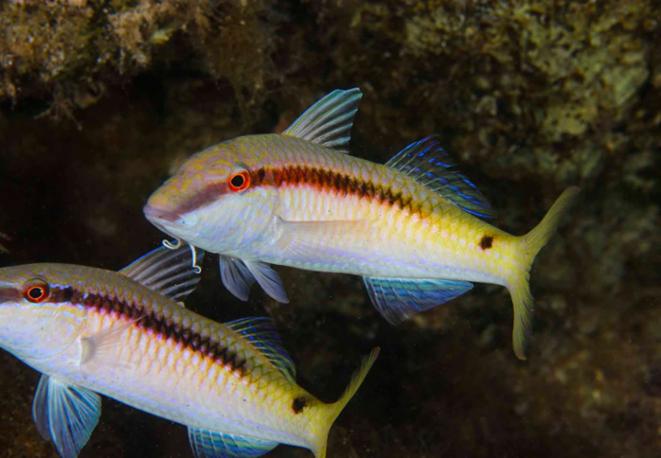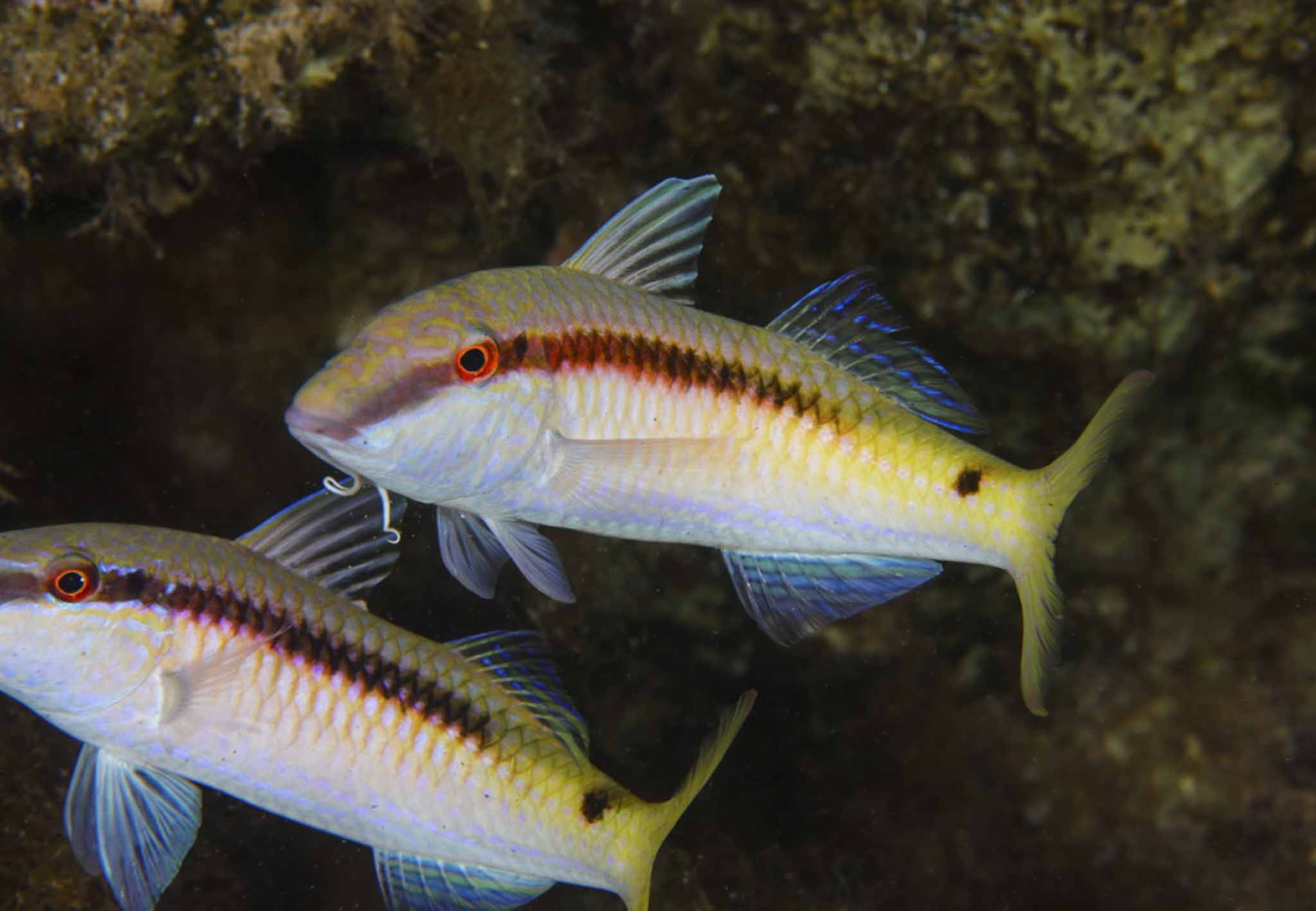
Gouband Goatfish
Upeneus moluccensis



Special Features
The Gouband Goatfish feels most comfortable over sandy and muddy bottoms near the coast, often close to reefs. Young individuals are still social, while adults tend to be solitary or in pairs. It is a fast swimmer that does not linger long: stop briefly, suck in prey, and off it goes. The diet mainly consists of small crustaceans and worms. Larger specimens may also indulge in a fish.
Appearance
The Moluccan barb is a slender, agile-looking fish with a stylish appearance: silvery-pink body, brown back, and a golden yellow stripe from head to tail. Its deeply forked tail fin with thin red stripes is particularly striking, almost as if it has been painted on purpose. With an average length of around 18 cm, it remains manageable, yet it catches the eye immediately.
Natural Enemies
Predatory fish
Dangerous/Toxic
This fish is neither toxic nor dangerous to humans but is considered an invasive species that affects local fish communities in the Mediterranean.
Pro Tips
The Gouband Goatfish can be best observed over sandy or muddy bottoms near the coast and reefs at depths between 10 and 120 meters, especially when young fish are traveling in small groups. It is a strong invasive species in the eastern Mediterranean that has quickly spread since the Lessepsian migration, displacing native benthic fish and adapting excellently to new habitats.