
Spiny spider crab
Maja crispata




Special features
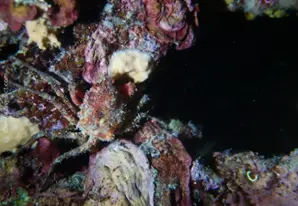
If you want to discover Little Spiders, you have to take a closer look, because they are masters at camouflage.
They attach foreign objects to the barbs on their bodies and thus appear to dissolve their body shape and become one with their environment. (Reminds a bit of Bootstrap Bill on the Flying Dutchman in Pirates of the Caribbean).
If they feel like it, they also use the algae and animals, which then grow and live on them, as a food source.
Appearance
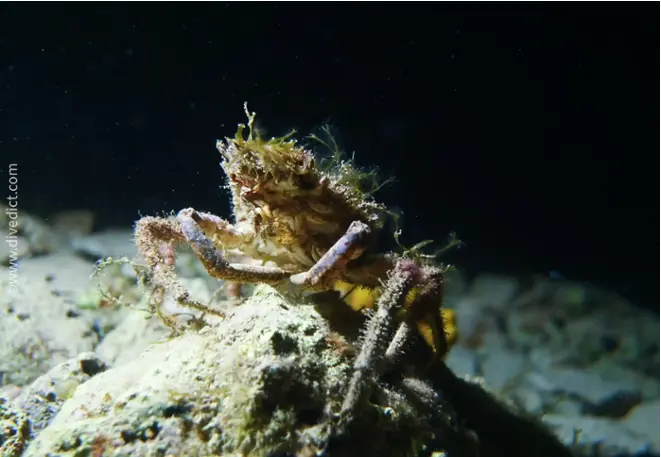
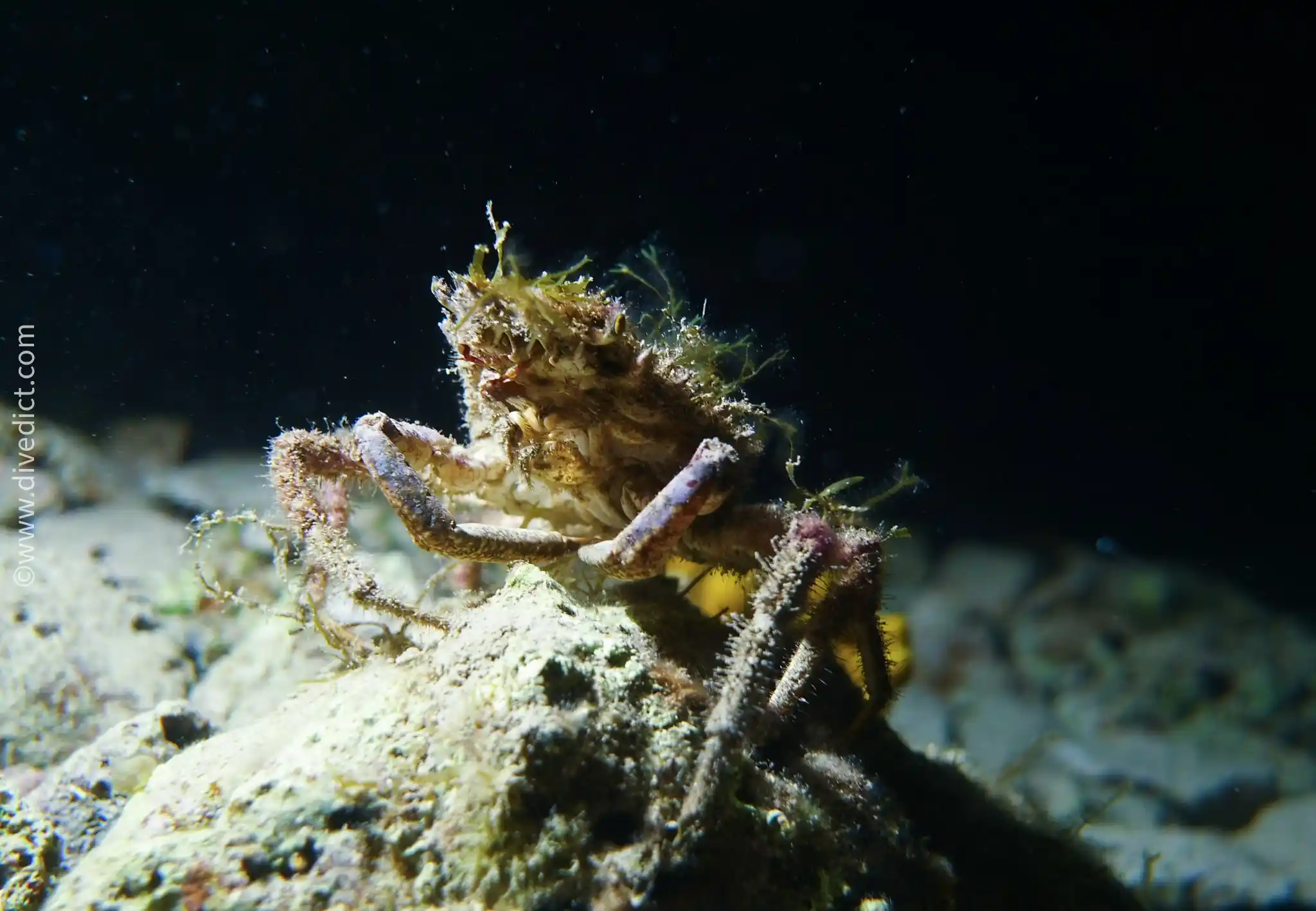
As the name suggests, spider spiders can be recognized by their long, spider-like legs. It also differs from other crabs by its rather triangular body, which is longer than wide.
Their base color is brownish to sand-colored.
Her entire body is covered with yellow bristles, which she uses to hook all kinds of algae, sponges, sea squirts, and even rocks onto herself.
After the last molting in their life cycle, the sexes can be clearly differentiated from one another: the scissors of males are then significantly larger than those of females.
Compared to other species, their scissors are small but still powerful.
Natural enemies
Dangerous/Toxic
When they feel threatened, spider spiders can behave aggressively, but they are by no means poisonous.
sketch


1. Triangular body
2. Small scissors
Pro Tips
Their excellent camouflage is used to protect against enemies. Its growth makes it truly inedible for most predators.
When they change their homes, so does their disguise.
Interestingly enough, they sometimes cover themselves with brightly colored sea squirts.
This is not necessarily unobtrusively disguised, but this is the best way for her to hide her crab shape and to sneak up on prey more easily.
From time to time, the spider has to separate itself from its camouflage to grow. However, it rarely happens that you can observe this procedure.
The animals are at their most vulnerable at this point and therefore hide in caves for their molting process or perform it under cover of night.
During the mating season, females can be easily distinguished from males by their wide, rounded abdomen with blue-black eggs.
Text: Carolina Leiter, Felician Hosp, Pia Balaka
Pic: Felician Hosp, Sabine Probst
Illustration: Dive Dict