
Portuguese Man o' War
Physalia physalis


Special Features
The Portuguese Man o' War is strictly speaking not a single jellyfish, but a so-called colonial organism. It consists of a colony of many highly specialized polyps that take on different tasks, such as locomotion, feeding, or reproduction. These individual components are so dependent on each other that they could not survive alone. However, together they act like a single living being, which makes them biologically particularly interesting and unique.
Appearance
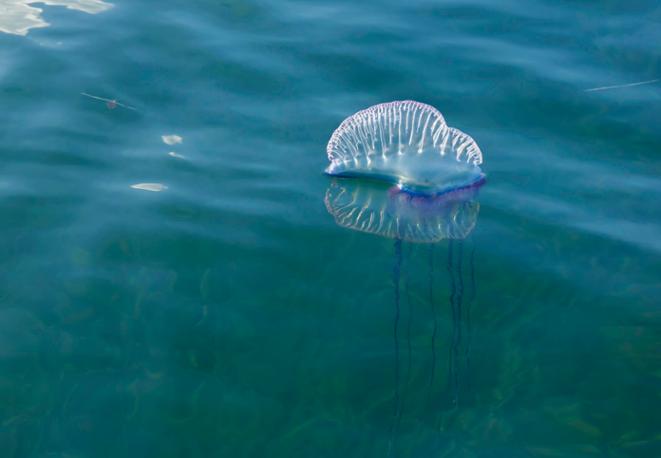
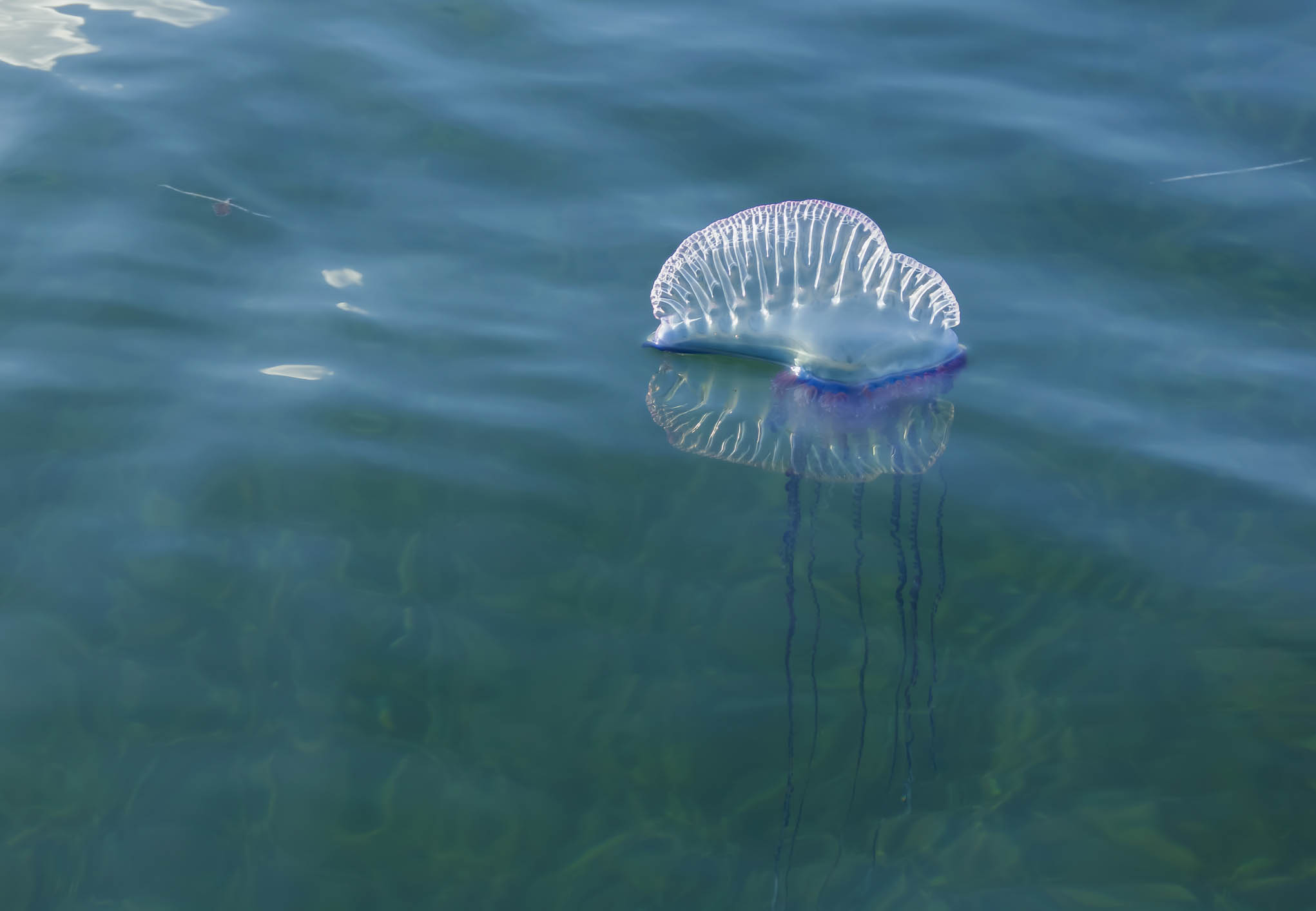
Characteristic is its striking, gas-filled float, which shimmers bluish to violet and drifts on the water's surface. This float can orient itself like a sail in the wind, allowing the Portuguese Man o' War to passively drift over long distances. Below the surface hang long, thread-like tentacles that can often reach several meters, and in some cases even over 20 meters in length. These tentacles are covered with numerous stinging cells and serve both for prey capture and defense.
Natural Enemies
Despite their toxicity, the Portuguese Man o' War has some natural enemies. These include mainly sea turtles, especially the leatherback turtle, which is relatively insensitive to the stinging toxins. Certain fish species, such as the Portuguese Man o' War fish (Nomeus gronovii), can also live among the tentacles and are partly resistant to the venom. These animals often use the Man o' War for protection against predators.
Dangerous/Toxic
The tentacles of the Portuguese Man o' War are very toxic and can cause severe pain upon contact. The stinging cells release a venom that can lead to skin irritations, redness, swelling, and in severe cases, allergic reactions or circulatory problems. It becomes particularly dangerous when larger areas of skin are affected or sensitive individuals are stung. Therefore, one should always maintain a safe distance.
Pro Tips
Even when the Portuguese Man o' War is dead or washed ashore, its tentacles remain active and can still cause painful stings long after it has died. Therefore, one should never touch them, neither in the water nor on the beach. If sighted in the sea, it is advisable to keep a sufficient distance and warn other bathers. In case of contact, the affected area should be rinsed carefully with seawater (not fresh water) and medical attention should be sought as soon as possible.


