
Blue crab
Callinectes sapidus




Special features
The blue crab is a true swimming artist. That's because of her fifth pair of legs, which is flattened like a paddle. One of the swimming legs regulates up and down movement, the other regulates forward movement.
Appearance
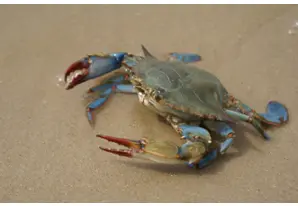
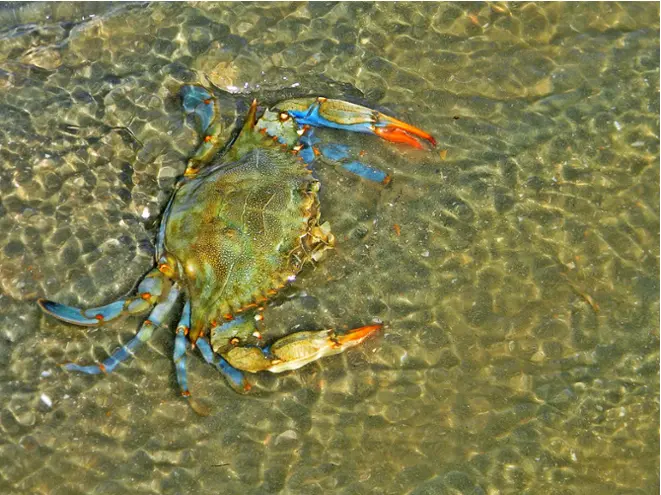
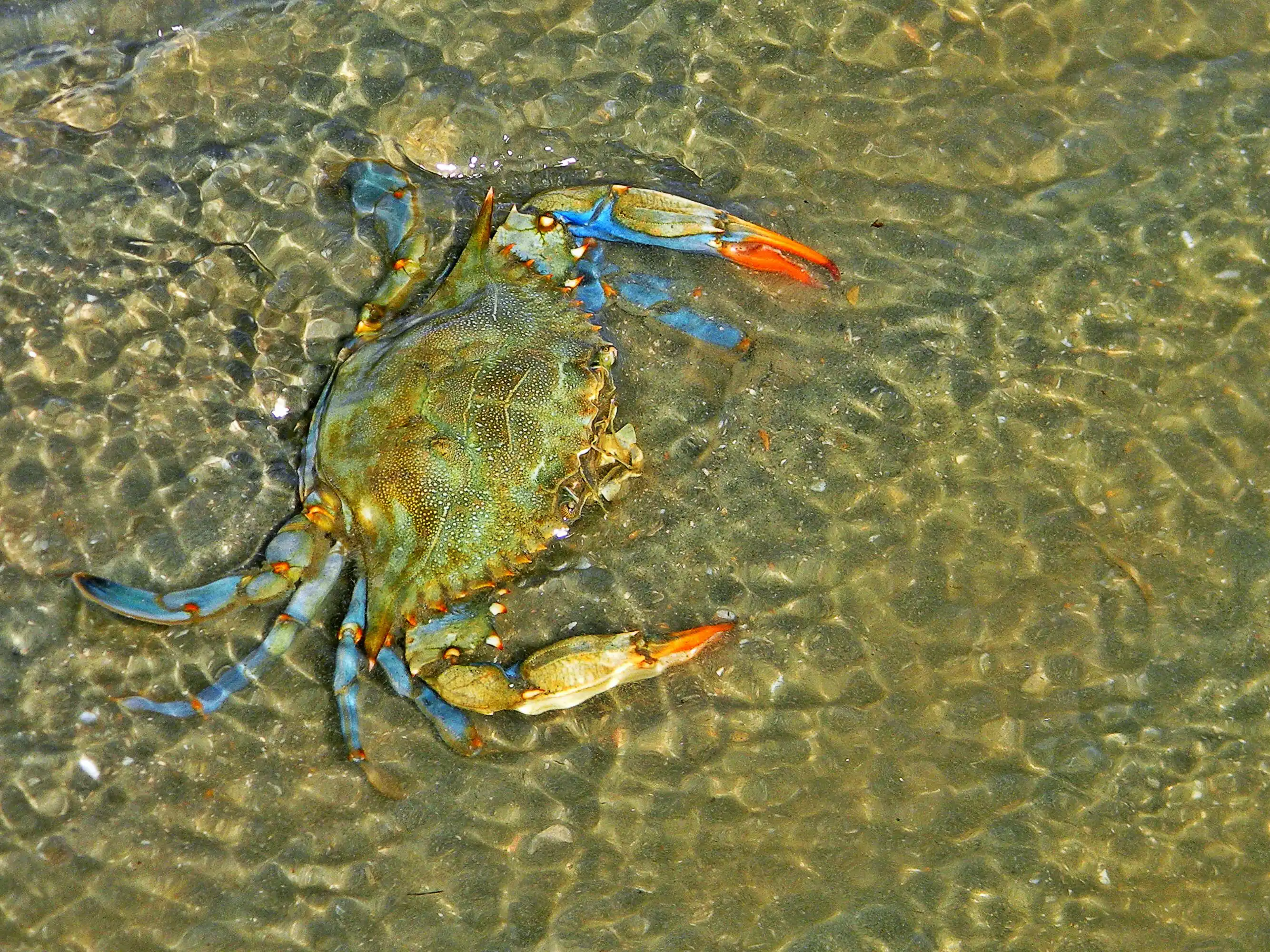
Her carapax is olive green to dark blue, and the ends of her scissors glow bright blue. In the case of females who can mate, their scissor tips are also bright red.
As with many crabs, both blue crabs have one pair of scissors larger than the other, i.e. the large cracking scissors and the smaller cutting scissors. Behind them, there are three pairs of strides and then a few more swimming legs.
The shape of its carapax is also characteristic of the blue crab because it tapers at the sides and ribbed along the front edge (looks almost a bit like a ruffle skirt). 9Measuring the carapax lengthwise, it can be over 20 cm long, a very nice giantess among crabs.
On the underside of the female body, the hard carapax covers more area, as they can protect the eggs underneath.
Natural enemies
None
Dangerous/Toxic
The blue crab is not poisonous, but its scissors are sharp and strong and it often behaves aggressively.
Sketch
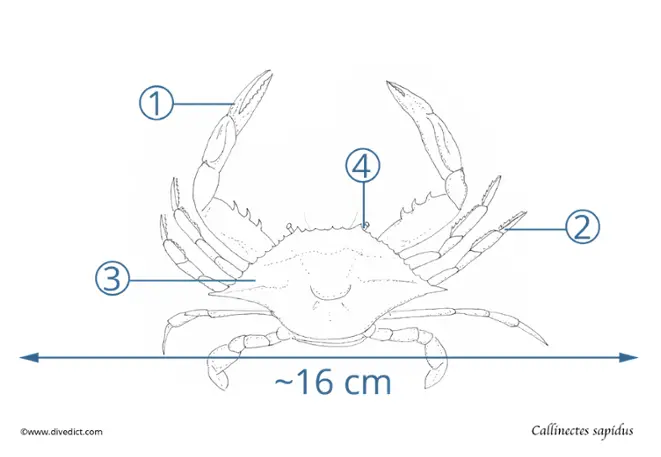
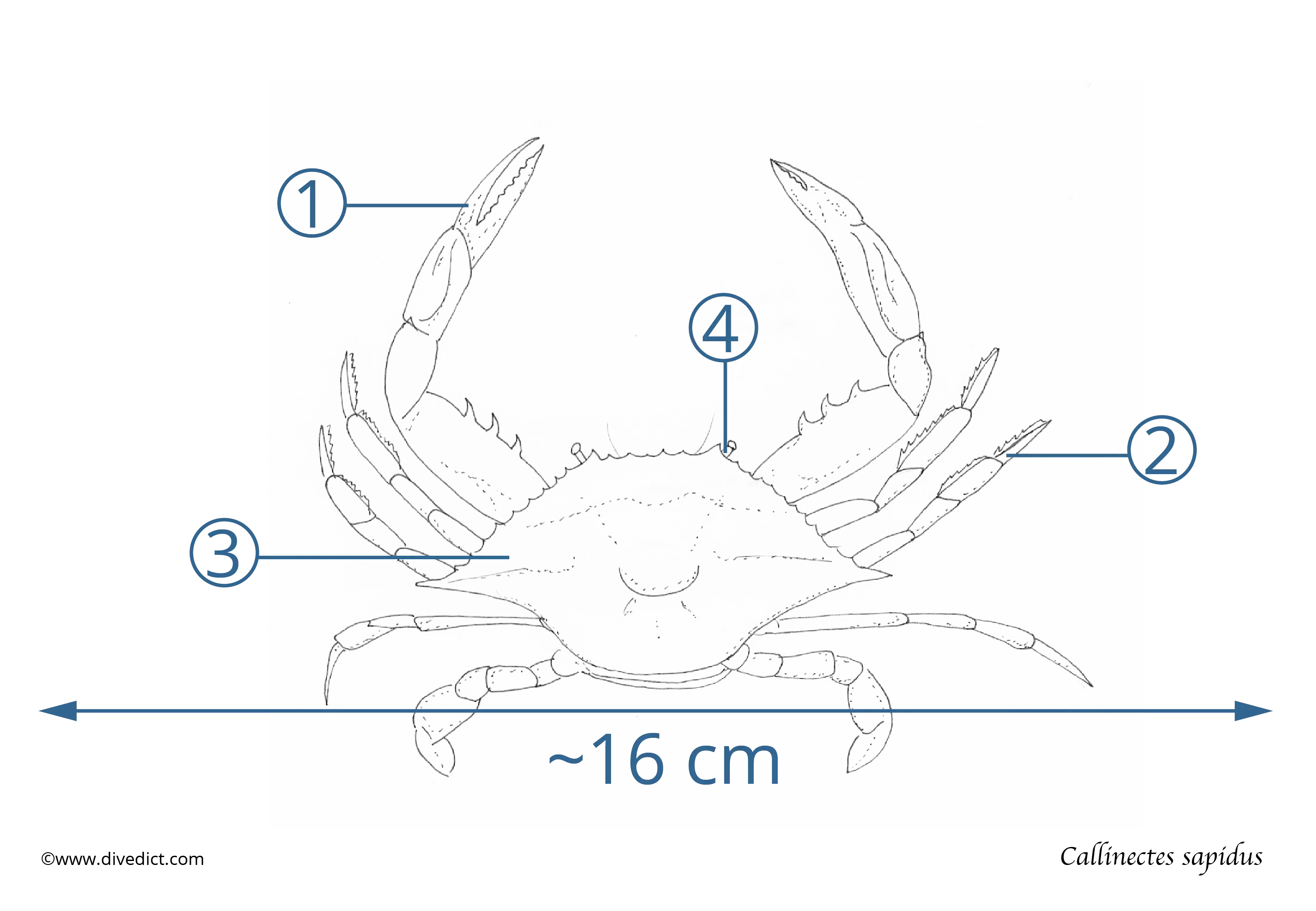
1. Cracking scissors
2. Walking legs
3. Carapax, pointed on the sides
4. Style eyes
Pro Tips
Its Latin name can be translated as beautiful or hearty swimmers and anyone who sees her swimming will also be enchanted by the sight of her maneuvering through the water with her scissors pulled in and with just her swimming legs.
Blue crabs live only 3 - 4 years and become sexually mature at the end of their first year of life. While the males grow out of their shells several times during their life, the females only experience a molting process, and that is just before they are ready to reproduce.
This is exactly what female blue crab males look for, they choose one, fertilize it after shedding the old shell, and continue to accompany it during the rest of the molting process. They are often seen running around or swimming as “biplanes”: the male carries the female on his back to make sure that no other guy mounts his female.
After that, the female can produce 750,000 to 3,200,000 eggs.
The blue crab is an invasive, non-native species in the Mediterranean Sea, originally from the western Atlantic coast and introduced to new areas through human activities such as ballast water discharge.
Text: Carolina Leiter, Felician Hosp
Illustration: Dive Dict